
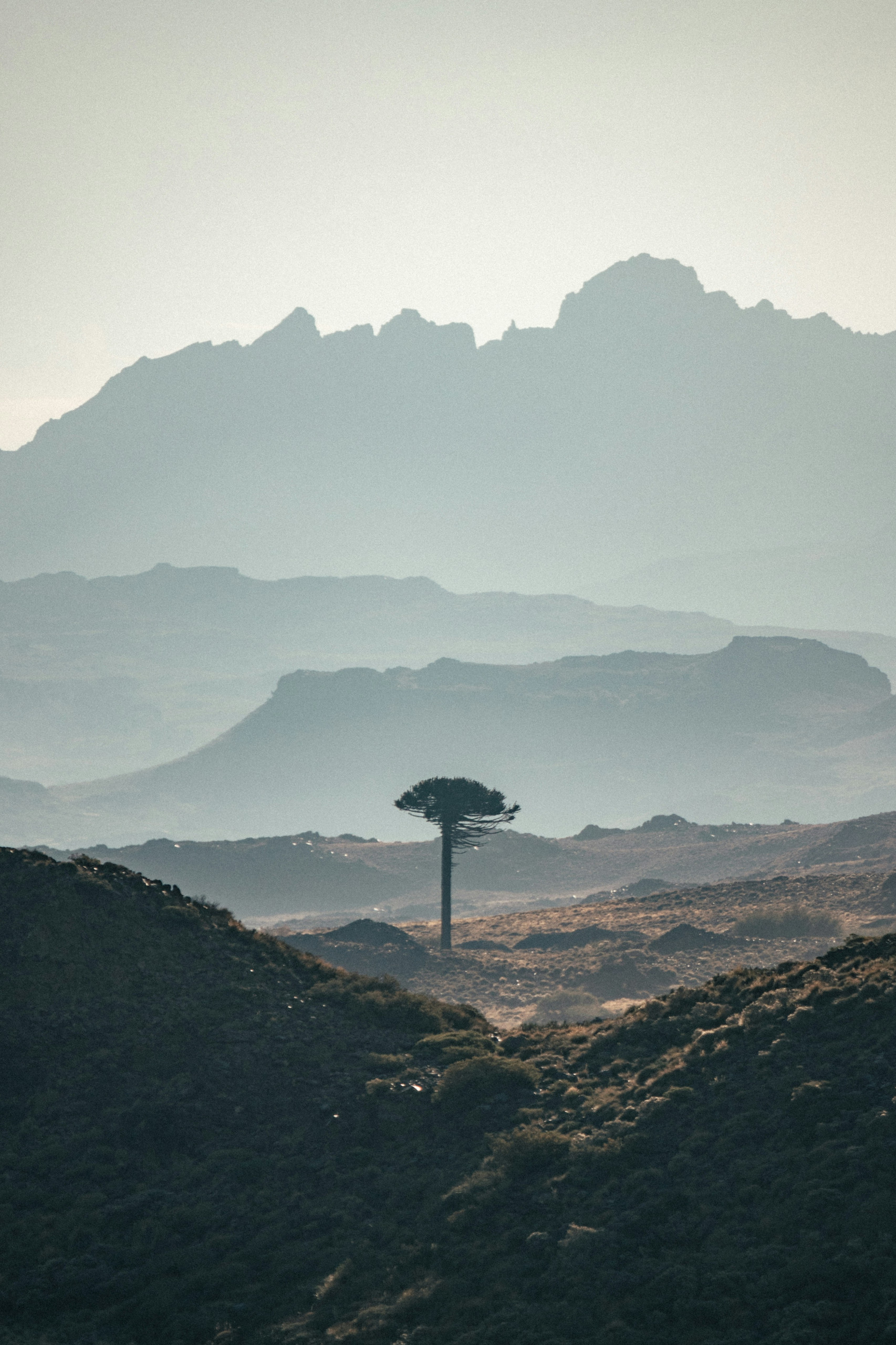
Araucaria tree in southern Chile.
Photo: Gustavo Zambelli / Unsplash
Understanding the tension between indigenous territory and industrial forestry in Chile
In the commune of Loncoche, in southern Chile, 80 Mapuche communities spent more than a decade organising to negotiate with one of the world’s largest forestry companies. The result was not a legal settlement or a political victory in the conventional sense. It was a building.
The Künü is a ceremonial space constructed on recovered ancestral land. It was designed by the Chilean architecture firm ELEMENTAL and built through a process led by the communities themselves. The space embodies a principle that is easy to state but difficult to practice: before you can negotiate, you must first get to know each other.
This is not a simple story of confrontation. It is a story about what becomes possible when both sides choose dialogue over escalation, and what remains unresolved even when they do.
Two words that Spanish does not have
To understand the depth of the Mapuche territorial conflict, it helps to start with language.
In Spanish, the word “tierra” carries two meanings that English separates into “land” and “Earth.” One refers to property: hectares, boundaries, legal titles. The other refers to the planet, to existence, to a living entity with which communities have a spiritual relationship.
For the forestry industry, the discussion is about land: ownership, productivity, economic return. For Mapuche communities, the discussion is about Earth: the foundation of identity, culture, and collective existence.
This linguistic ambiguity is not trivial. It means that when both parties sit at a table to discuss “the land question,” they are often talking about fundamentally different things without realising it. One side sees a resource. The other sees the root of who they are.
The Künü project began with the recognition that this gap had to be addressed before any productive negotiation could take place.
A brief history of the conflict
The Mapuche people inhabited southern Chile for over 2,000 years, maintaining their independence even during Spanish colonisation. In 1881, the Chilean army militarily occupied Mapuche territory, known as Wallmapu, displacing communities into small reservations.
Nearly a century later, in 1974, the Pinochet dictatorship introduced Decree Law 701, which subsidised industrial pine and eucalyptus plantations. Many of these plantations were established on ancestral Mapuche lands. Today, approximately 2.3 million hectares of industrial forestry plantations cover the regions where the Mapuche historically lived.
The forestry industry is economically significant in the region. It generates employment and contributes to local economies. At the same time, it restricts access to lands that communities consider central to their cultural survival. Both of these realities coexist, and the tension between them has no clean resolution.
The asymmetry of knowledge
When the forestry company Arauco and an association of Mapuche communities in Loncoche decided to approach each other, they encountered an obstacle deeper than disagreement: a fundamental asymmetry of knowledge.
As one community leader noted during the process: the Mapuche know about Chile, but Chileans have no idea about the Mapuche.
This imbalance shapes every interaction. Without genuine understanding of Mapuche culture, history, and worldview, the dominant society fills the gaps with assumptions and stereotypes. Proposals intended as solutions often arrive “out of scale,” disconnected from community realities, reinforcing the perception that dialogue is just another way to achieve nothing.
The architectural firm ELEMENTAL, led by Alejandro Aravena, was called by both parties to design a physical space that could contribute to their rapprochement. But before any design could begin, the architects had to do something unusual: unlearn everything they thought they knew about the conflict, and simply listen.
Designing for dialogue
The Künü space emerged from that listening process. Its design reflects principles drawn directly from Mapuche cosmology and the practical needs of communities that had never had civic architecture on their territory.
The form is circular, inspired by a freehand drawing in the air, breaking away from the rigid geometry of Western institutional buildings. It is oriented east, a fundamental axis in the Mapuche worldview, aligning the structure with the solar cycle. It is built entirely from wood, so that it feels familiar in a landscape shaped by forests. And it is vertical, visible from a distance, acting as a landmark where none had existed before.
Crucially, the Künü was conceived not as a single building but as a sequence. A small city, not a big building. This approach introduced time into the design: rather than promising everything at once and risking disillusionment, the project grows incrementally. Each phase builds on the trust earned in the previous one.
The design philosophy was deliberately described as “more or less.” More or less a circle. More or less oriented east. This was not imprecision. Technically, the structure was calculated to the last millimeter. The openness was intentional: design had to leave space for the unknown, for what the communities would bring to the space after it was built.
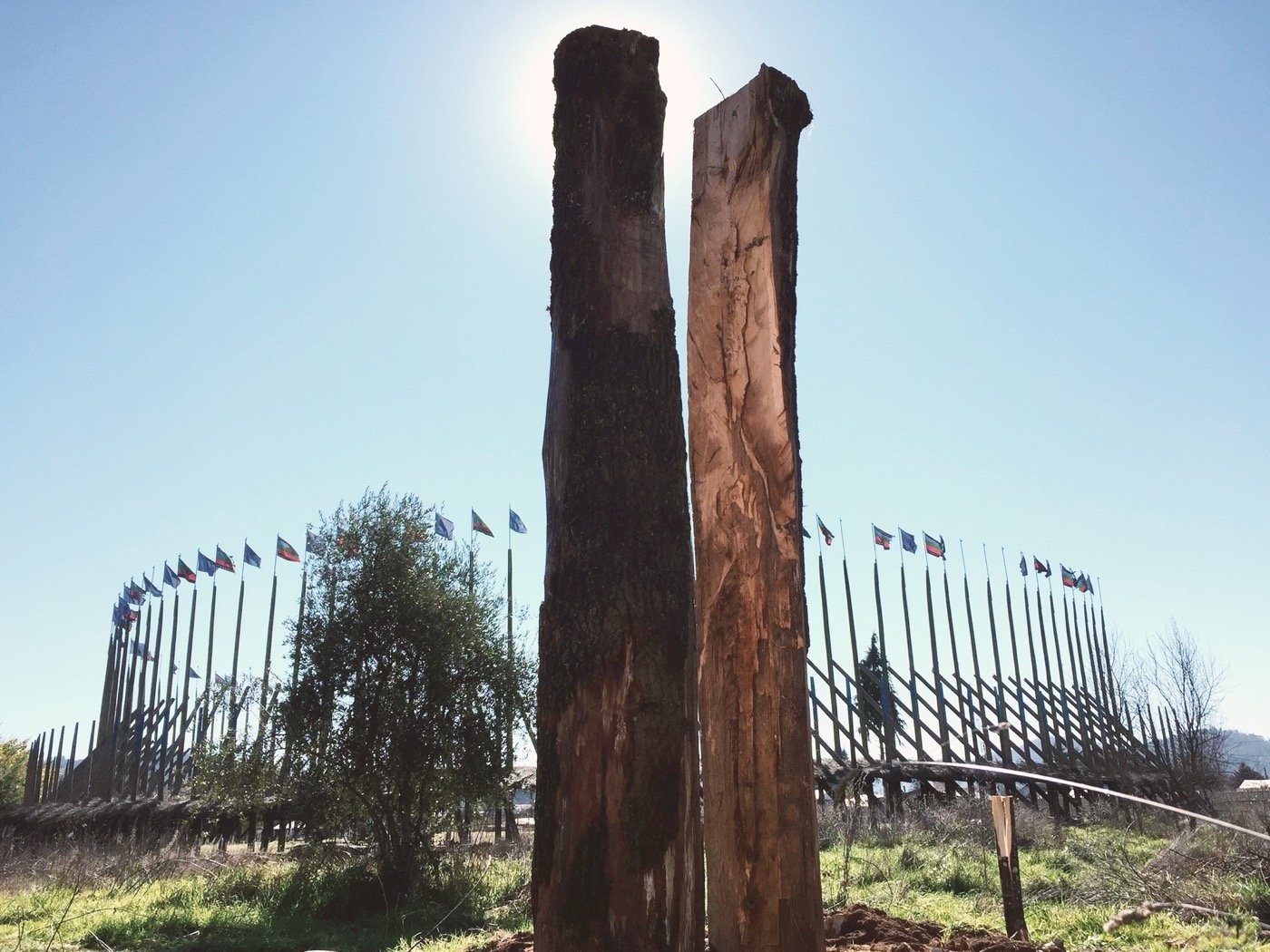
The vertical wooden posts of the Künü space, with the circular structure and community flags in the background. Loncoche, Araucania region, Chile.
Photo: ELEMENTAL (via Landezine)
What the community brought
This is where the documentary Künü, directed by Mapuche filmmaker Francisco Huichaqueo Pérez, reveals something the architect’s perspective cannot.
During construction, community leaders recognised in the vertical wooden posts a memorial dimension that had not been part of the original design. The posts evoked the memory of ancestral lonkos who were decapitated during colonisation. What was designed as architecture became a space of historical reparation.
The communities also brought the Koyaktun, their parliamentary tradition. The word “parlamentar” (to parliament) is a verb in Spanish, though it has fallen out of common use. For the Mapuche, it describes a formal process of dialogue and negotiation that predates the Chilean state. The Künü space enabled the recovery of this tradition in a physical form.
The documentary shows the celebration of We Tripantu, the Mapuche New Year, around the sacred canelo tree within the recovered space. It shows communities that are not merely resisting or preserving, but innovating: creating new forms from ancient principles.
As one attendee at our screening observed: “Mapuches are innovators. We usually have the preconception that working with indigenous communities is always about preserving what is there. But this was a new creation.”
What remains unresolved
The Künü was inaugurated in December 2022. The space exists and is used by the communities. But the broader territorial conflict between Mapuche communities and the forestry industry remains unresolved.
The distinction between Künü (getting to know each other) and Koyaüwe (formal negotiation) is important here. The space that exists is for mutual recognition. Whether it will open the path to formal territorial negotiation is an open question. The documentary ends without resolution, and intentionally so.
The forestry industry continues to operate on ancestral territory. Communities continue to face pressures on their land, their culture, their identity. The Künü is a beginning, not an ending.
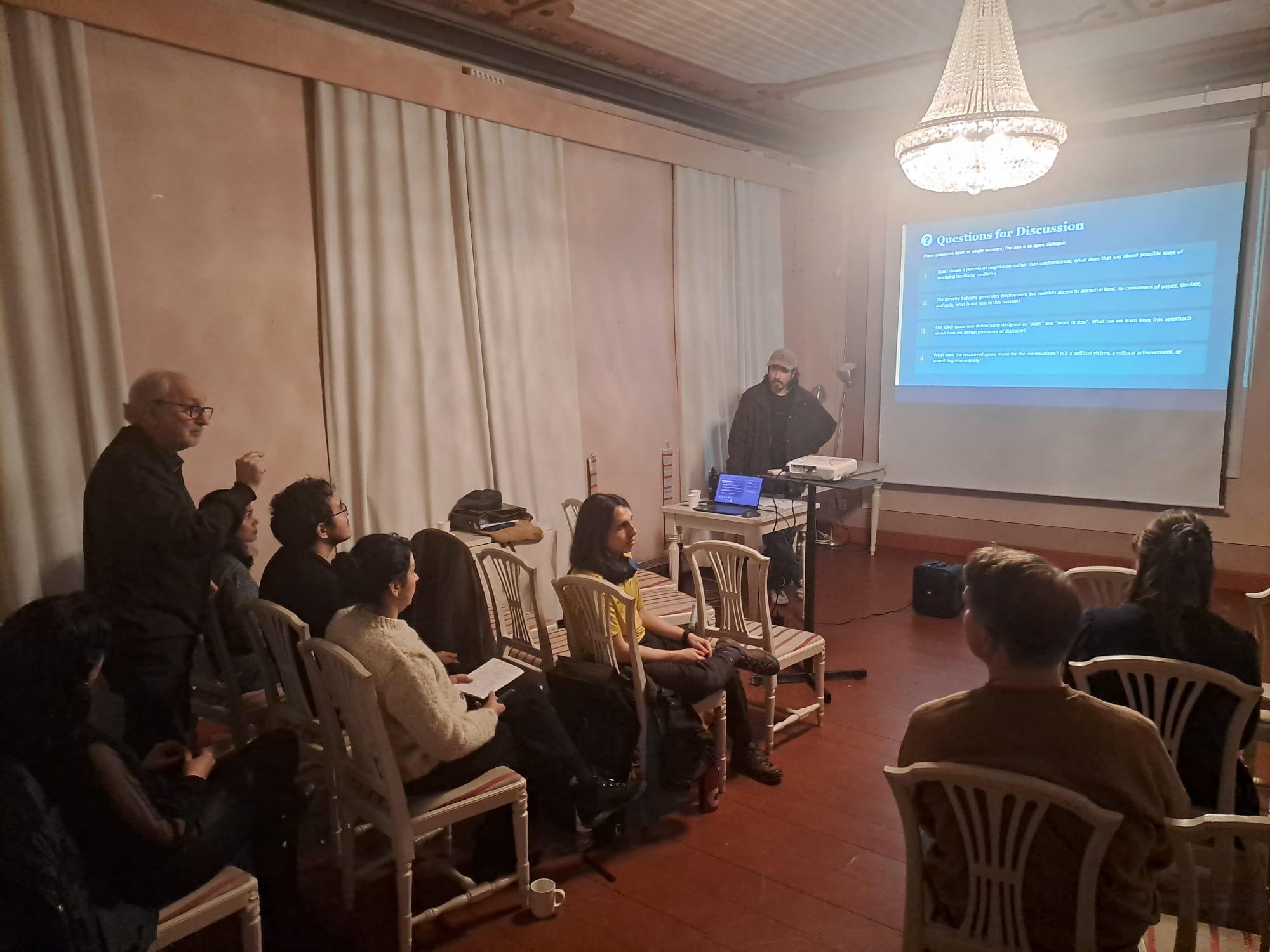
Post-screening discussion at Stadin yhteisötalo Oulunkylän Seurahuone, Helsinki, 19 March 2026.
Photo: GoSphereX
Why GoSphereX shares this context
GoSphereX is not an advocacy organisation. We do not take a position for or against the forestry industry or any specific company. We present structural patterns and tensions because understanding the systems that shape territories is part of environmental accountability.
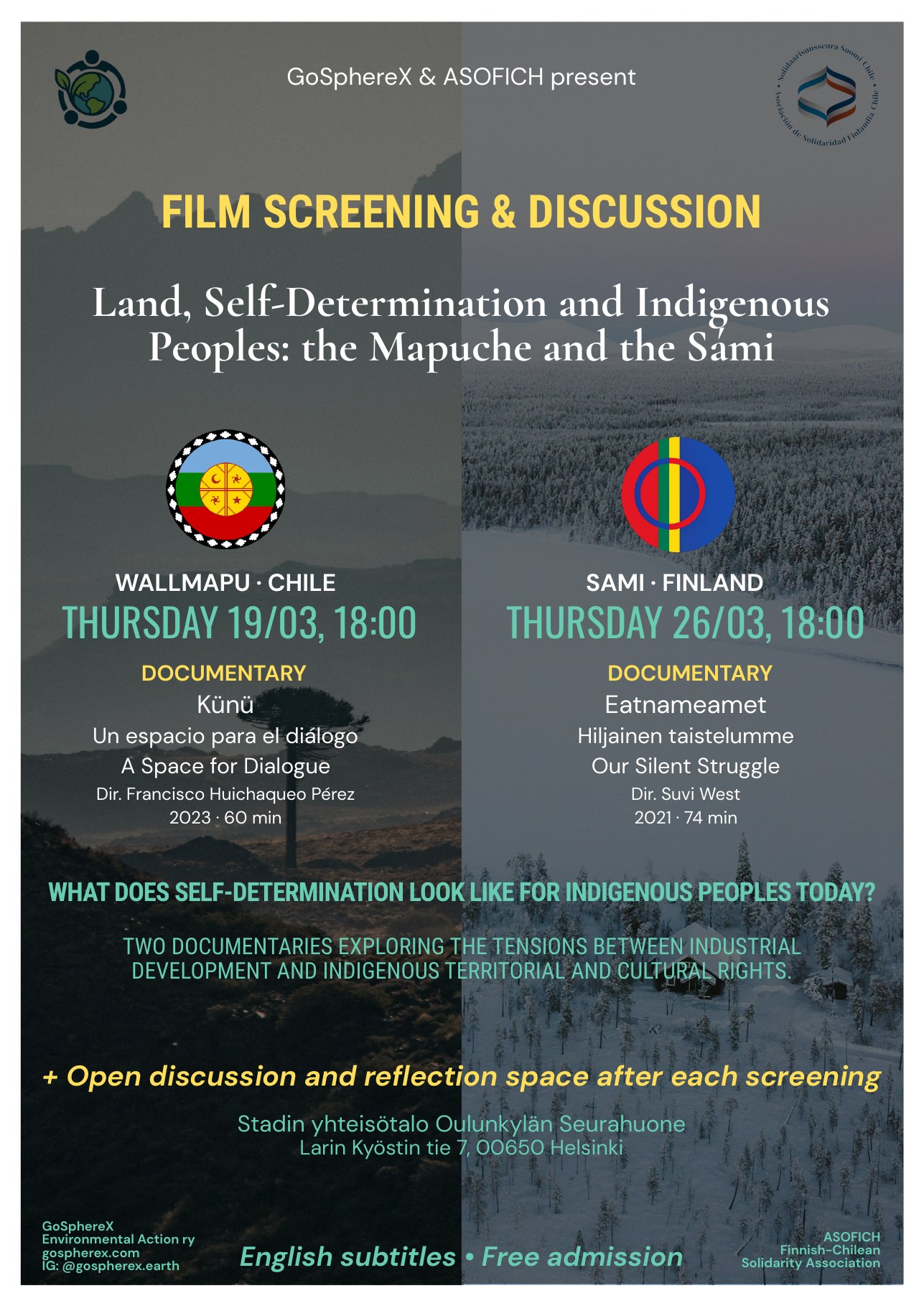
This screening was the second session of a documentary series organised by GoSphereX and ASOFICH (the Finnish-Chilean Solidarity Association) in Helsinki. Its first three sessions examined how different development models affect indigenous territories and communities, from lithium extraction in the Atacama to forestry in Wallmapu to State policy towards the Sami people in Finland.
The connection to GoSphereX’s work is not abstract. Our pilot project, Vertientes de La Chimba Norte, supports community-led wetland restoration in Antofagasta, in the same country where these tensions play out. Understanding the broader context in which local restoration happens is part of what we do.
Environmental education is one of GoSphereX’s core activities. We believe that meaningful environmental action requires understanding complexity, not simplifying it.
About the documentary
Künü: Un espacio para el diálogo (A Space for Dialogue)
Director: Francisco Huichaqueo Pérez, 2023, approximately 60 minutes. Spanish with English subtitles.
Selected at LASA Festival 2024, Smithsonian Mother Tongue Film Festival, 36th Festival de Cine Latinoamericano de Toulouse. Municipal Art Prize 2025.
The screening was preceded by a short film produced by ELEMENTAL for the Venice Architecture Biennale 2021 (theme: “How will we live together?”), which presented the architect’s perspective on the Künü project.
Note
This article provides educational context for GoSphereX’s environmental education mission. Historical and contextual information is drawn from the documentary, publicly available sources, and discussions held during the screening event in Helsinki on 19 March 2026.
GoSphereX does not take political positions on forestry policy or territorial conflicts. We do not speak on behalf of indigenous communities. We present structural patterns to inform understanding.
Follow GoSphereX on LinkedIn or Instagram for updates on environmental accountability and community-led action.
Cover image at the top of this page: Araucaria forest in southern Chile. Photo: Jason Hollinger, CC BY 2.0, via Wikimedia Commons.